

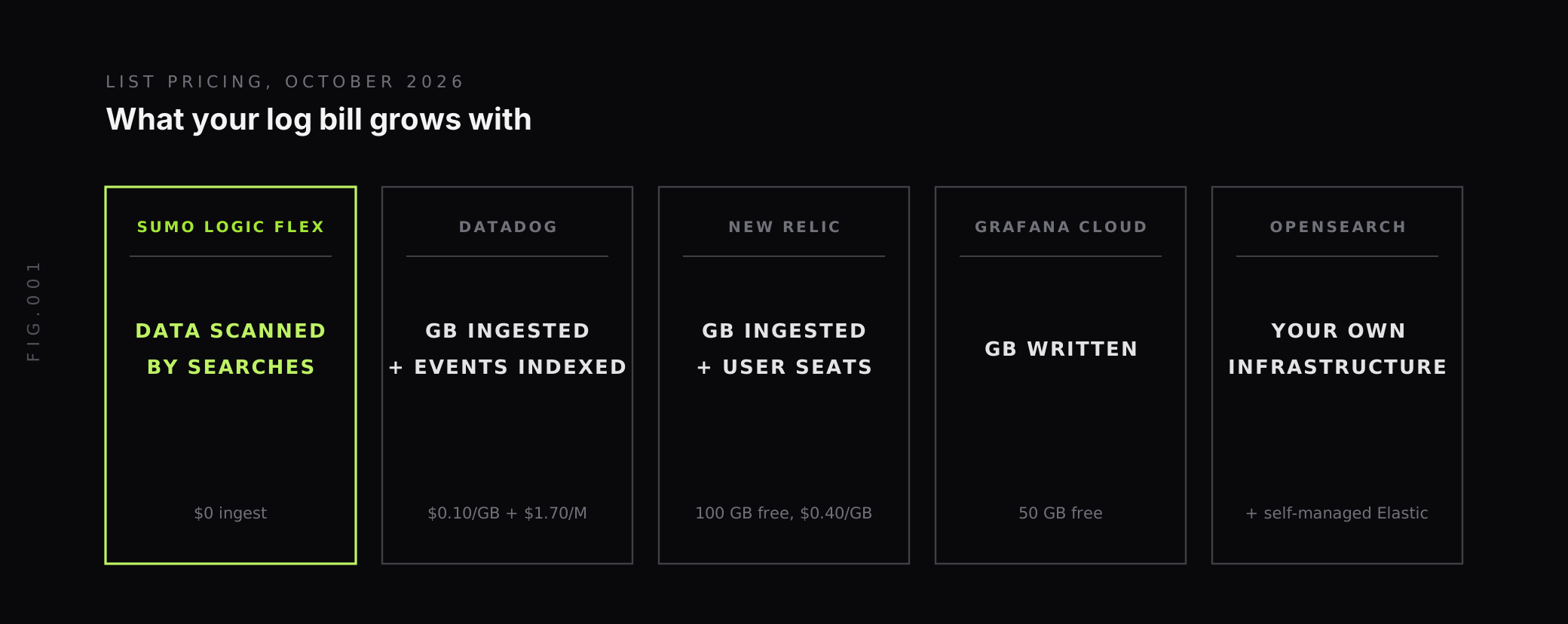
The main Sumo Logic alternatives are Last9, Datadog, Splunk, New Relic, Grafana Cloud, Elastic and OpenSearch. They differ most in how they bill for logs. Sumo Logic’s Flex licensing charges nothing to ingest and bills for the data your searches scan. Datadog bills to ingest and again to index. New Relic and Grafana Cloud bill per GB, and OpenSearch is open source and costs whatever it takes to run it.
The right alternative depends on why you’re leaving. If query-based billing makes costs hard to predict, a per-GB model is easier to forecast. For security analytics, Splunk and Elastic are the closest fits. If you want logs next to metrics and traces with control over what you keep, look at all-in-one platforms such as Last9, Datadog or New Relic.
This guide covers why teams look for Sumo Logic alternatives, how seven of them compare, and how to migrate without losing alerts. Pricing figures are list prices from each vendor’s public pricing pages and docs as of October 2026.
Why do teams look for Sumo Logic alternatives?
Sumo Logic is a mature cloud log analytics and SIEM platform. The reasons teams evaluate alternatives are usually about its pricing model and its direction, not whether it works.
Scan-based billing is harder to forecast. Under Flex licensing, Sumo Logic’s pricing page lists “$0 ingest” and “unlimited data ingest”, and you pay for analytics instead. Its Flex FAQ explains what that means in practice: “you will be billed for all default scope partitions that are not explicitly excluded”, and “Using keywords or other metadata in a query will not reduce the amount of data scanned.”
A dashboard that runs a broad query every minute can scan far more data than you ingest. Sumo Logic recommends limiting queries to a single partition and using short time ranges.
There is no public price. The pricing page shows scan tiers in “scans per GB ingested” and an estimator, but no price per GB or per TB scanned. Enterprise pricing comes through sales or an authorized reseller.
It’s a credits system. Essentials plans use tiered credits, and Flex uses its own credits. Sumo Logic says it doesn’t charge penalty rates after the fact for ingest spikes, which is a real benefit, but credits make cost comparisons with per-GB vendors harder.
It’s now privately owned. Francisco Partners completed its acquisition of Sumo Logic on May 12, 2023, for about $1.7 billion, and the stock left Nasdaq. Some teams re-evaluate vendors after ownership changes.
For a deeper look at the plans, see our breakdown of how Sumo Logic pricing works.
What should you look for in a Sumo Logic alternative?
Five things decide whether a replacement works for your team:
- Billing unit. Per GB ingested, per event indexed, per GB scanned or per GB written. Pick the unit that grows slowest for how you use logs.
- Query language. Your saved searches and alerts are written in Sumo Logic’s query language. Check how much effort rewriting them takes, and whether the new tool uses an open language such as LogQL or SQL.
- Retention and archives. Compliance logs often need a year or more. Check what retention costs and whether old data can live in cheaper storage you can still query.
- OpenTelemetry support. Sending logs through the OpenTelemetry Collector keeps your pipeline portable, so the next migration is a config change.
- Security needs. Sumo Logic sells Cloud SIEM as part of its Enterprise Suite. If your security team depends on it, you need a replacement for that too, not only for log search.
How do the Sumo Logic alternatives compare?
| Tool | Log costs (list, October 2026) | Deployment | Best for |
|---|---|---|---|
| Last9 | No meter per active series or per GB | SaaS, or single-tenant in your own AWS or GCP account (Glassbox) | Logs, metrics and traces together, with control at ingest |
| Datadog | From $0.10/GB to ingest, plus $1.70 per million events indexed (15-day, annual) | SaaS | One vendor for infrastructure, APM, logs and security |
| Splunk | Not listed publicly | SaaS (Splunk Cloud) or self-hosted (Splunk Enterprise) | Large security and log analytics teams |
| New Relic | 100 GB/month free, then $0.40/GB, plus paid user seats | SaaS | Many hosts, modest data volume |
| Grafana Cloud | Per GB written, 50 GB/month free | SaaS; Loki can be self-hosted | Teams already on Prometheus and Grafana |
| Elastic | Hosted or self-managed; self-managed means your own infrastructure | SaaS or self-hosted | Search-heavy log and security workloads |
| OpenSearch | Free under Apache 2.0; you pay for infrastructure | Self-hosted or managed services | Teams that want fully open source |
1. Last9
Last9 is an observability platform for metrics, logs and traces, built around OpenTelemetry. Logs arrive over OTLP or the OpenTelemetry Collector, and you can query them in the Logs Explorer, including with LogQL in Editor Mode, or through the embedded Grafana with a Loki data source.
Strengths:
- Control at ingest: our Control Plane lets you drop, remap, redact, forward and aggregate metrics, logs and traces at ingest, so noisy log streams don’t have to reach storage.
- Physical Indexes: you can split high-volume or team-specific logs, such as CDN or proxy logs, into their own query space so searches over them stay fast.
- Correlation: logs sit next to metrics and traces, and we handle 20M series per metric per day by default, with no sampling.
- Deployment: Glassbox runs single-tenant inside your own AWS or GCP account for teams with data residency requirements.
Considerations:
- Last9 is an observability platform, not a SIEM. If your security team relies on Sumo Logic’s Cloud SIEM, you’ll need a separate security tool.
- Saved Sumo Logic searches need rewriting in LogQL or the query builder.
Best for: engineering teams that use logs mainly for debugging and want them correlated with metrics and traces, with rules to control what they keep.
2. Datadog
Datadog is an all-in-one platform covering infrastructure, APM, logs, real user monitoring and security. Its log pricing separates ingesting a log from indexing it for search.
Strengths:
- Broad integration catalog and one agent for most signals.
- Ingest and indexing are billed separately, so you can ingest everything and index only what you search often.
- Flex Logs storage for high-volume logs costs from $0.05 per million events stored per month on annual billing, with retention from 1 to 15 months.
Considerations:
- Log ingest starts at $0.10 per GB, and Standard Indexing costs $1.70 per million log events a month with 15-day retention on annual billing, or $2.55 on demand.
- Datadog’s log billing docs say usage above your commitment is charged on demand “with a 50% premium.”
- SaaS only, with no self-hosted option.
Best for: teams that want one vendor for everything and are ready to manage indexing rules actively. Our Datadog pricing breakdown covers the other meters.
3. Splunk
Splunk is the long-established platform for log analytics and security operations, available as Splunk Cloud Platform or self-hosted Splunk Enterprise. Cisco completed its acquisition of Splunk on March 18, 2024, at $157 per share, roughly $28 billion in equity value.
Strengths:
- Mature search language and a large library of apps and integrations.
- Strong security products, which makes it the closest match for teams that use Sumo Logic as a SIEM.
- Self-hosted option for teams that need full control of their data.
Considerations:
- Splunk doesn’t publish simple per-GB list prices, so costs need a quote.
- Splunk’s search language is powerful but has a learning curve, and Sumo Logic searches need rewriting.
Best for: large security and compliance teams. See our Splunk cost breakdown and Splunk alternatives.
If your team searches Sumo Logic mainly to debug services rather than for security, Last9 keeps those logs next to metrics and traces, and Control Plane rules drop noisy streams at ingest.
4. New Relic
New Relic is an all-in-one observability platform priced on data ingested plus users, not hosts.
Strengths:
- 100 GB of data ingest free each month, then $0.40 per GB on the original data option.
- Unlimited free basic users, so many people can view dashboards.
- No per-host fee, which suits container-heavy environments.
Considerations:
- The Data Plus option costs $0.60 per GB instead of $0.40.
- Full platform users on Pro cost $349 per user per month on an annual commitment, or $418.80 monthly, so seat costs grow with team size.
- SaaS only.
Best for: teams with many hosts and modest log volume. Our New Relic pricing breakdown goes deeper.
5. Grafana Cloud
Grafana Cloud is Grafana Labs’ managed service built on Loki for logs, alongside Mimir for metrics and Tempo for traces. Loki can also be self-hosted.
Strengths:
- Grafana Cloud’s logs docs say billing is based “on the volume of data you send and keep”, with 50 GB free before written volume is charged.
- Queries are included up to 100 times your written log volume each month.
- LogQL is an open query language, and the same stack can be self-hosted to reduce lock-in.
Considerations:
- Loki indexes labels rather than full log content, so searches across large volumes depend on good label design.
- Minimum retention is 30 days on paid accounts, with longer storage charged per GB for each extra 30 days.
Best for: teams already running Prometheus and Grafana. See our Grafana Cloud pricing breakdown and our guide to Loki for log management.
6. Elastic
Elastic builds Elasticsearch and Kibana, the core of the ELK stack, and offers them as Elastic Cloud or self-managed. In August 2024 Elastic announced it would add AGPL as a license option alongside the Elastic License v2 and SSPL.
Strengths:
- Full-text search across log content, which suits investigations where you don’t know the right label in advance.
- Strong security analytics, which makes it another realistic replacement for Sumo Logic’s SIEM use.
- Self-managed deployment for full control.
Considerations:
- Running Elasticsearch yourself means managing shards, storage tiers and upgrades.
- Indexing full log content takes more storage and compute than label-only indexing.
Best for: teams that need full-text search and security analytics and have the skills to run or tune Elasticsearch. See our guides to what the ELK stack is and Elastic vs Splunk.
If you want data in your own cloud without running a search cluster, Last9 runs single-tenant in your own cloud account, in any region, and we manage it for you. You query logs with LogQL instead of tuning shards.
7. OpenSearch
OpenSearch is a fork of open source Elasticsearch 7.10, and its FAQ says all of its software is released under the Apache License 2.0. The Linux Foundation launched the OpenSearch Software Foundation on September 16, 2024, to host the project, which AWS had hosted since 2021.
Strengths:
- Fully open source with no license fee.
- Vendor-neutral governance under the Linux Foundation.
- Available self-hosted or as a managed service, such as Amazon OpenSearch Service.
Considerations:
- Self-hosting puts storage, scaling and upgrades on your team, the same as Elasticsearch.
- Features and APIs have drifted from Elasticsearch since the fork, so check plugin and tool compatibility.
Best for: teams that want open source with no license questions and can run a search cluster. Our ELK alternatives post covers more self-hosted options.
How do you migrate off Sumo Logic?
Switching log platforms fails when alerts break silently. A dual-shipping period avoids that.
- Inventory what you use. List the scheduled searches, monitors, dashboards and saved searches that people open or that page someone. Older accounts often carry searches nobody opens any more.
- Send logs to both platforms. Route logs through an OpenTelemetry Collector with two exporters, so Sumo Logic and the new platform get the same data.
- Rebuild the important queries and alerts. Start with alerts that page someone, then the dashboards used in incidents.
- Compare for two to four weeks. Check that counts and alerts match, and that the new platform fires the same alerts at the same time.
- Cut over. Move alert routing to the new platform, then remove the Sumo Logic exporter.
The OpenTelemetry Collector’s contrib distribution includes a Sumo Logic exporter, so step 2 is a configuration change. This example sends the same logs to Sumo Logic and to Last9 over OTLP:
exporters:  sumologic:    endpoint: <HTTP_Source_URL>  otlphttp/last9:    endpoint: https://otlp.last9.io    headers:      Authorization: <your Last9 authorization header>
service:  pipelines:    logs:      receivers: [filelog]      processors: [batch]      exporters: [sumologic, otlphttp/last9]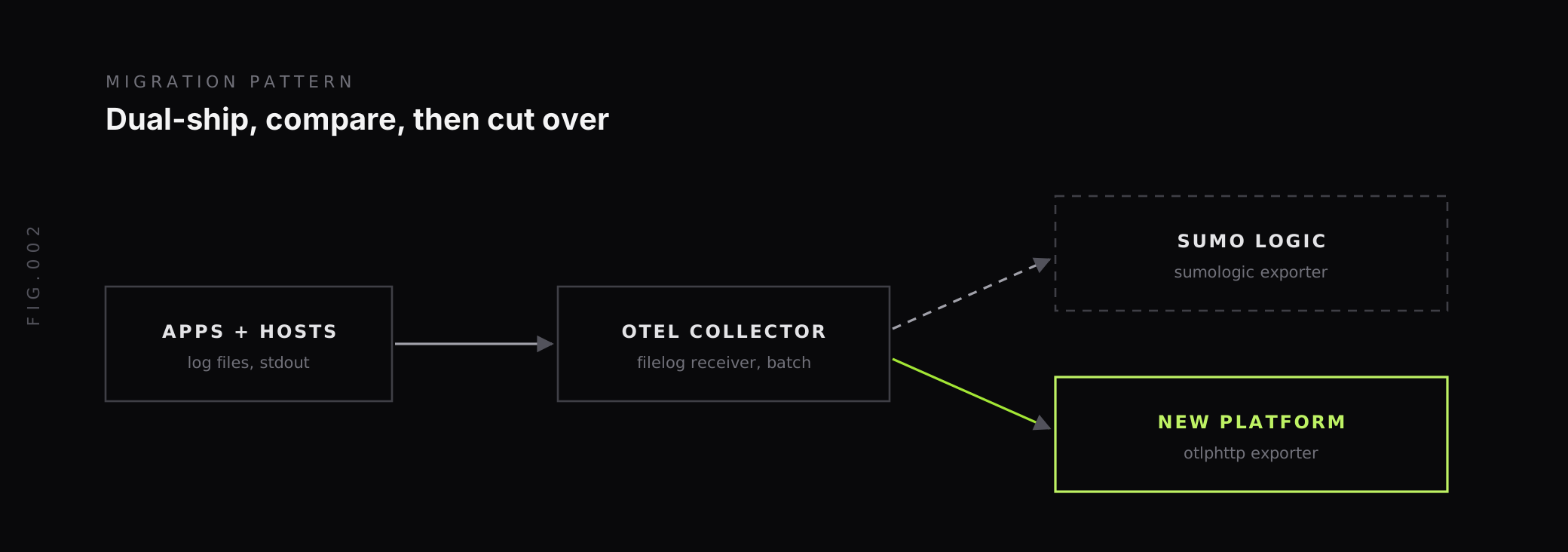
Use the dual-shipping period to drop noisy logs too. Debug logs from healthy services and repeated health-check lines are usually the first candidates, and the OpenTelemetry Collector can filter them before they reach either platform.
Match the billing model to how you use logs
Sumo Logic’s move to Flex made ingest free and made search the thing you pay for. That suits teams that keep a lot of logs and query them rarely. It suits teams with many dashboards and broad scheduled searches less well, because scan volume grows with every query.
Start by working out which of your costs grow fastest: volume, indexing, search or seats. Then shortlist two or three alternatives whose billing unit grows slowest for that, and dual-ship before you switch. If you want logs next to metrics and traces, with rules for what you keep at ingest, Last9 takes OpenTelemetry logs directly.
FAQ
What are the best Sumo Logic alternatives?
The most common Sumo Logic alternatives are Last9, Datadog, Splunk, New Relic, Grafana Cloud, Elastic and OpenSearch. Datadog and New Relic are all-in-one platforms, and Splunk suits large security teams. Grafana Cloud and Elastic have self-hostable cores, and OpenSearch is fully open source. Last9 fits teams that want logs, metrics and traces together with control at ingest.
How does Sumo Logic pricing work in 2026?
Sumo Logic sells credits. On its Flex licensing, log ingest is listed at $0 and you pay for analytics, measured by the volume of data your searches scan. Adding keywords to a query doesn’t reduce the data scanned; only scoping to partitions does. Essentials plans use tiered credits instead. Sumo Logic doesn’t publish list prices per GB or per TB scanned.
Is there a free or open source alternative to Sumo Logic?
Yes. OpenSearch is released under the Apache License 2.0 and can be self-hosted for free. Grafana Loki and Elasticsearch can also be self-hosted, with Elasticsearch available under AGPL, SSPL or the Elastic License. Managed options with free allowances include Grafana Cloud, with 50 GB of logs a month, and New Relic, with 100 GB of data ingest a month. Last9 is not open source, but it takes logs from the OpenTelemetry Collector, so a pipeline built for a self-hosted backend can point at Last9 later with an exporter change.
Who owns Sumo Logic?
Sumo Logic is owned by Francisco Partners, a private equity firm. The acquisition closed on May 12, 2023, at $12.05 per share in cash, an equity value of about $1.7 billion, and Sumo Logic’s stock stopped trading on Nasdaq at that point.
Is Datadog cheaper than Sumo Logic for logs?
It depends on how you use logs. Datadog charges from $0.10 per GB to ingest logs and $1.70 per million log events to index them with 15-day retention on annual plans, so cost follows volume. Sumo Logic Flex charges $0 to ingest and bills for data scanned by searches, so cost follows how much and how widely you query. Teams that ingest a lot and search rarely tend to favor scan-based billing. Last9 has no meter per active series or per GB, and its Control Plane drops noisy logs at ingest, before they reach storage.
How do you migrate from Sumo Logic to another platform?
Inventory the searches, dashboards, scheduled searches and alerts you use, then send the same logs to Sumo Logic and the new platform at the same time, for example with an OpenTelemetry Collector that has two exporters. Rebuild the most important queries and alerts in the new platform, compare results for two to four weeks, then switch alerting over and stop sending to Sumo Logic.


