

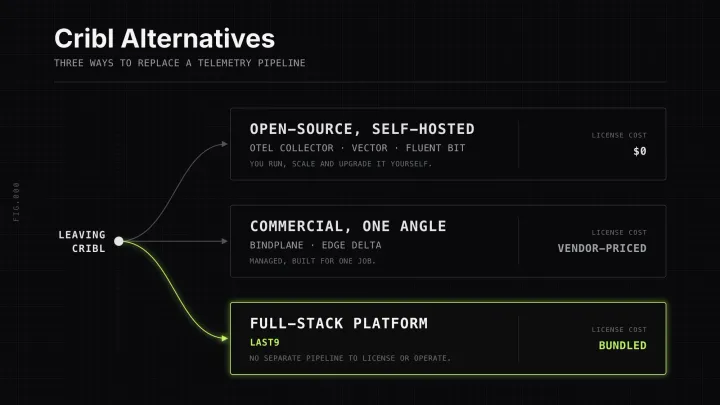
The best Cribl alternatives fall into three groups: open-source pipelines you run yourself (OpenTelemetry Collector, Vector, Fluent Bit), commercial pipeline-plus-agent platforms built for one angle (Bindplane, Edge Delta), and full-stack platforms like Last9 that fold pipeline shaping into storage, query, and alerting rather than selling it separately.
Which group fits comes down to one question. Do you want a standalone router that stays neutral across many destinations, or would you rather stop paying for a routing layer and a backend as two separate line items?
Most Cribl competitors are evaluated by one of two audiences: observability teams trying to control a metrics and logs bill, and SecOps teams routing data into a SIEM. The tools below serve both, but they don’t serve them equally, so each entry notes which job it suits.
What is Cribl, and what does it do?
Cribl is a telemetry data company whose core product, Cribl Stream, is a pipeline that collects, filters, transforms, and routes logs, metrics, and traces from their sources to one or more destinations. Teams most often place it in front of an expensive backend like Splunk, to cut the volume and cost of what gets ingested there.
Stream sits alongside Cribl Edge for agent-side collection and Cribl Lake for storage. When people say “Cribl” in a pipeline discussion, they usually mean Stream.
Cribl is not a SIEM and not an observability backend. It doesn’t store, index, or query your data — it decides what reaches the tools that do. That distinction matters when you compare it to the alternatives below, because some of them replace the pipeline and some replace the reason you needed one.
Why are teams looking for Cribl alternatives?
Cribl Stream earned its reputation honestly. It’s a mature, well-built telemetry pipeline that many large security and observability teams run in production, and it remains one of the most capable tools for shaping data before it hits an expensive backend like Splunk.
The complaints that send people looking elsewhere aren’t about whether it works. They’re about what it costs to run, and how much expertise it takes to run well.
On cost, aggregated reviewer feedback on PeerSpot describes Cribl as “a very costly product,” with one reviewer noting that “people nowadays have started considering alternative[s]”, and pricing comparisons calling out that “the cost part is very high compared to alternatives such as Edge Delta.”
The same review set raises a separate concern: that Cribl “charges for data visibility rather than processed data.” Reviewers flagged this as a problem for smaller teams weighing it against flatter-priced options.
On complexity, Cribl’s own marketing makes the case better than any competitor could. The company built and shipped an AI assistant, Cribl Copilot, to shorten onboarding. Its own announcement post is candid about why: “There is always a learning curve. This knowledge gap causes resistance to change, deployment issues, configuration errors, integration mismatches, and delayed adoption.”
That same PeerSpot review set separately flags “complex initial setups and systemic problems during upgrades, especially for large-scale deployments,” plus outdated documentation and long sales cycles. When a vendor builds a dedicated AI product to compress its own onboarding curve, the curve is real.
What should you look for in a Cribl alternative?
Four things matter more than a feature checklist when comparing pipeline tools:
- How pricing scales as volume grows — per-GB, per-node, or bundled into a platform you already pay for.
- Open-source and self-hosted, or managed and commercial — this decides who carries the operational load.
- Destination breadth — how many backends it can route to, versus how tightly it is built around one.
- Operational overhead — upgrades, scaling workers, and tuning parsers all land on either your team or the vendor.
Quick comparison: the best Cribl alternatives
| Tool | Type | Best for | Self-hosted? |
|---|---|---|---|
| Last9 | Full-stack platform with built-in Control Plane | Teams that want pipeline shaping and the observability backend in one product | Runs in your own cloud account, managed by Last9 |
| OpenTelemetry Collector | Open-source, vendor-neutral | Teams standardizing on OTel who want zero licensing cost | Yes, self-hosted |
| Vector | Open-source, Rust-based | Teams that want a fast, config-driven router and don’t mind Datadog now owning the project | Yes, self-hosted |
| Fluent Bit | Open-source, CNCF (Fluentd subproject) | Lightweight log/metric collection at the edge, especially in Kubernetes | Yes, self-hosted |
| Bindplane | Commercial, OTel-native | Teams that want OTel’s neutrality with a managed, no-code layer on top | Managed |
| Edge Delta | Commercial, agent-based | Teams wanting AI-assisted incident correlation built on top of edge collection | Managed |
Bottom line: pick an open-source pipeline if you want zero licensing cost and can absorb the operational work. Pick a commercial pipeline if you want the routing job managed. Pick a full-stack platform if the pipeline was only ever a means to control the bill.
What are the best open-source Cribl alternatives?
Three open-source projects cover most of what Cribl Stream does, with no licence fee: the OpenTelemetry Collector for vendor-neutral shaping across any OTLP backend, Vector for high-throughput transforms in Rust, and Fluent Bit for lightweight collection at the edge.
All three are free to run. The trade is operational: you own the deployment, the scaling, and the upgrade cycle, and you configure them in YAML rather than a visual UI.
The 6 best Cribl alternatives, compared
1. Last9
Last9 is a full-stack observability platform with a Control Plane built in. Teams can drop, route, aggregate, and reshape logs, metrics, and traces before they hit storage — the same core job Cribl does.
The difference is where the shaped data lands: directly in a platform that already handles metrics, logs, traces, RUM, and alerting with cross-signal correlation. The pitch isn’t “a better pipeline.” It’s “no separate pipeline product to license, run, and keep patched in the first place.”
Key features: pre-storage drop/remap/redact/forward/aggregate via the Control Plane, one licence with the infrastructure on your own cloud bill, 100+ native integrations, correlation across metrics/logs/traces/RUM once data lands, and single-tenant deployment in your own cloud account, on AWS or GCP in any region, managed by Last9.
Pros: no separate pipeline vendor to manage on top of your observability backend; one licence instead of per-GB or credit pricing, with no charge per label or metric name; shaped data is immediately queryable, correlated, and alertable without a second export step.
Cons: Last9’s Control Plane can forward data to other destinations, but it is built around Last9’s own platform, not as a neutral router fanning out to five different third-party backends simultaneously the way Cribl is. If you need one pipeline feeding Splunk, S3, and a SIEM all at once while keeping your options fully open, Cribl’s vendor-neutral design is still the more purpose-built tool for that job.
Best for: teams who want the pipeline-shaping benefit without buying, running, and licensing a separate pipeline product.
2. OpenTelemetry Collector
The OpenTelemetry Collector is the CNCF’s own vendor-neutral collection and processing layer, free, open-source, and increasingly the default starting point for teams who don’t want to commit to any single vendor’s pipeline before they’ve decided on a backend.
Key features: receivers/processors/exporters architecture for arbitrary telemetry shaping, no licensing cost, backed by the same standards body behind OTel itself, broad ecosystem of community-built components.
Pros: vendor-neutral by design, zero license cost, backed by a large open-source community, works with any backend that speaks OTLP.
Cons: you own the deployment, scaling, and upgrade cycle yourself; configuration is YAML-based rather than a visual UI, so the learning curve is real even if the software is free; no built-in AI-assisted troubleshooting the way some commercial options now offer.
Best for: teams standardizing on OpenTelemetry who are comfortable running and tuning it themselves.
3. Vector
Vector is an open-source, Rust-based observability data pipeline originally built by Timber Technologies, acquired by Datadog in 2021. It remains open-source under Datadog’s stewardship and is usable independently of any Datadog product, but that ownership is worth knowing if vendor neutrality is why you’re leaving Cribl.
Key features: high-throughput, low-latency processing written in Rust, a config-driven transform model, broad source and sink support across logs, metrics, and traces.
Pros: fast, resource-efficient, free and open-source, active development.
Cons: now maintained under a competing observability vendor’s roof, which some teams treat as a dealbreaker for a “neutral” pipeline; like the OTel Collector, it’s self-hosted and self-operated.
Best for: teams that want Cribl-like transform performance without the license cost, and don’t mind who currently stewards the project.
4. Fluent Bit
Fluent Bit is a lightweight log and metrics processor, and a subproject of the CNCF-graduated Fluentd project. It targets exactly the footprint Cribl workers don’t: small, fast agents running at the edge, especially inside Kubernetes as a DaemonSet. Its primary commercial steward, Calyptia, was acquired by Chronosphere in early 2024, though Fluent Bit itself remains a community-governed open-source project.
Key features: minimal memory and CPU footprint, native Kubernetes and container log collection, a large library of input/output plugins, pairs with the heavier Fluentd for aggregation further downstream.
Pros: lightweight, free, huge existing deployment base, well-suited to high-cardinality container environments.
Cons: less capable than Cribl or Vector at complex, stateful transforms; configuration and plugin quality vary since it’s a broad open-source ecosystem rather than one vendor’s polished product.
Best for: teams that need a lightweight collection agent at the edge rather than a full transform-heavy pipeline.
5. Bindplane
Bindplane (formerly observIQ, renamed in January 2025) is a commercial, OpenTelemetry-native pipeline that layers a managed, no-code interface on top of the OTel Collector rather than building proprietary pipeline technology from scratch, aimed at teams who want OTel’s neutrality without hand-writing YAML for every pipeline change.
Key features: built entirely on the open OpenTelemetry standard, a visual no-code configuration layer, centralized management across many collector instances, cost-reduction framing aimed at the same “why is my observability bill so high” problem Cribl targets.
Pros: OTel-native so it stays portable across backends, easier for teams that don’t want to hand-roll Collector configs, managed rather than fully self-hosted.
Cons: smaller ecosystem and track record than Cribl’s years of enterprise deployments; less publicly documented pricing than Cribl’s own credit system.
Best for: teams that want OpenTelemetry’s vendor neutrality with less hands-on YAML management than the raw Collector requires.
6. Edge Delta
Edge Delta has repositioned from a pure telemetry pipeline into what its own homepage now calls a “telemetry-native AI SRE”: agent-based collection at the edge, plus autonomous AI agents that correlate alerts, investigate root cause, and propose fixes for human approval rather than just routing data.
Key features: agent-based (not centralized) collection and processing, prebuilt AI “teammates” for SRE, security, and software-engineering-flavored investigation, automated root-cause correlation across distributed systems.
Pros: a different angle, less about routing data and more about acting on it; agent-based architecture avoids a centralized processing bottleneck.
Cons: the AI-agent positioning is a meaningfully different product bet than Cribl’s routing-first focus, so it’s not a drop-in replacement if routing flexibility is what you need; newer positioning means a shorter enterprise track record than Cribl’s.
Best for: teams more interested in automated incident correlation than in pure data routing.
How does Cribl’s pricing actually work?
Cribl Stream uses a consumption-based credit system rather than a flat per-GB rate. The mechanics are publicly documented, even though the dollar impact for any given setup takes some arithmetic to work out.
One Cribl Credit equals one US dollar. The published rates:
| Deployment | Rate per GB ingested | Infrastructure charge |
|---|---|---|
| Cloud-hosted workers | 0.32 credits ($0.32) | Yes, based on capacity you provision |
| Hybrid (your own workers) | 0.26 credits ($0.26) | None |
| Free tier | $0 up to 1TB/day | None |
Unused credits roll over annually up to a 20% cap, and the excess is then forfeited.
The free tier is generous enough that a small team can run Cribl at no cost. It is a separate no-cost account tier, though, not an allowance deducted from a paid account. Once you move onto a paid plan, every ingested GB is billable, not only the GBs above 1TB/day.
So a team ingesting 2TB/day on cloud-hosted workers pays on the full volume, roughly 60TB a month. At $0.32/GB, that comes to about $19,200/month, or roughly $230,000/year, on ingest credits alone — before the infrastructure credit is added on top.
Cribl doesn’t publish its infrastructure-credit consumption rate. Third-party pricing breakdowns estimate it adds another meaningful amount at that scale, based on community-reported figures rather than Cribl’s own documentation. That gap between the published rate and the final bill is precisely the “charges for data visibility rather than processed data” complaint reviewers raised.
Which Cribl alternative should you choose?
Cribl Stream is a capable, mature telemetry pipeline. The complaints driving people to alternatives are about cost predictability and setup complexity, not whether the product works. Match the replacement to the reason you’re leaving:
- Vendor-neutral routing across many destinations — the OpenTelemetry Collector, Vector, or Fluent Bit cover it for free, at the cost of running and tuning them yourself.
- A managed layer on top of OTel — Bindplane keeps the neutrality and takes the YAML away.
- AI-assisted incident correlation over routing flexibility — Edge Delta has moved decisively in that direction.
- One less product to license and operate — a full-stack platform folds the shaping step into the backend.
That last case is what Last9’s Control Plane is built for. You drop, route, aggregate, and reshape data on the way in, then query, correlate, and alert on it in the same platform.
Billing is one licence, with the infrastructure on your own cloud bill, rather than a credit system you have to reverse-engineer to predict your own bill.
Evaluating infrastructure and tooling vendors more broadly? Our guides to AWS alternatives and Splunk alternatives follow the same evaluate-honestly format used here.
FAQ
What is Cribl used for?
Cribl, and in particular its core product Cribl Stream, is a telemetry pipeline that collects, filters, transforms, and routes logs, metrics, and traces from their sources to one or more destinations, commonly used to reduce the volume and cost of data sent to an expensive backend like Splunk before it’s ingested there.
What does Cribl do?
Cribl Stream collects telemetry from your existing agents and sources, then filters, reshapes, enriches, and routes it to one or more destinations before it is stored. The practical job is volume control. Teams use it to drop noisy data, trim fields, and aggregate events so that a costly backend such as Splunk ingests less. Cribl does not store, index, or query the data itself.
Is Cribl a SIEM?
No. Cribl is a telemetry pipeline that feeds a SIEM rather than replacing one. SecOps teams commonly place Cribl Stream in front of Splunk, Microsoft Sentinel, or a data lake, to cut ingest volume and route a copy of the raw data to cheaper storage. The detection, correlation, and investigation still happen in the SIEM downstream.
Is there a free alternative to Cribl?
Yes. The OpenTelemetry Collector, Vector, and Fluent Bit are all free, open-source telemetry pipeline tools that cover much of the same collection, transformation, and routing functionality as Cribl Stream. The tradeoff is that you run, scale, and upgrade them yourself rather than paying a vendor for a managed service.
How much does Cribl Stream actually cost?
Cribl uses a credit-based system where 1 credit equals $1. Cloud-hosted workers cost $0.32 per GB ingested plus a separate infrastructure charge based on provisioned capacity; hybrid deployments (self-managed workers) drop to $0.26 per GB with no infrastructure charge. There’s a separate free tier covering up to 1TB/day, which is a no-cost account tier rather than a discount applied to a paid account. Cribl does not publicly document the exact infrastructure-credit consumption rate, so total cost at scale takes some estimation beyond the published per-GB numbers.
Is Vector still open source now that Datadog owns it?
Yes. Datadog acquired Timber Technologies, the company behind Vector, in 2021, but Vector remains an open-source project that can be run independently of any Datadog product. Teams that put vendor neutrality first should factor in that a competing observability vendor now stewards the project, even though the software itself is unrestricted.
What’s the difference between a telemetry pipeline and a full observability platform?
A telemetry pipeline, like Cribl Stream, the OpenTelemetry Collector, or Vector, collects, transforms, and routes data to a destination; it doesn’t store, query, or visualize that data itself. A full observability platform, like Last9, does both. It can shape data on the way in and also store, correlate, query, and alert on it, which removes the need to license and operate a separate pipeline product on top of the backend it feeds.
Does switching away from Cribl mean losing pipeline functionality?
Not necessarily; it depends on which alternative you pick. Open-source options like the OpenTelemetry Collector, Vector, and Fluent Bit cover similar collection and transformation functionality for free, at the cost of self-hosting. Platforms like Last9 fold the pipeline-shaping step directly into the observability backend, so the functionality doesn’t disappear; it moves from a standalone product into the platform that also stores and queries the data.


