

RAG Pipeline Observability: What to Trace at Every Stage
RAG pipeline observability guide: the spans, attributes and metrics to record for embedding, retrieval, reranking and generation, plus evals for bad answers.

Sejal Pandey
AI Agent Observability: What to Trace and What It Catches
AI agent observability means tracing tool calls, reasoning steps, and handoffs, not just tokens and latency. Here's what to instrument and why.
Sejal Pandey
Best AI Observability Tools in 2026: 8 Tools Compared
Eight LLM and AI agent observability platforms compared: what each tracks, pricing and free tiers, self-hosting options, and who each is built for.
Sejal Pandey
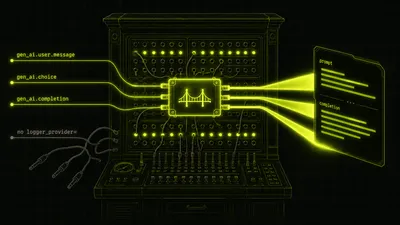
last9-genai: Closing the Conversation Gap in LLM Observability
OpenTelemetry's GenAI instrumentation gives you spans and token counts. It does not give you conversations, workflow cost rollups, or prompts visible in your dashboard. last9-genai is an OTel extension that fills those three gaps — without replacing your existing observability stack.

Prathamesh Sonpatki
10,000 GPUs, One TSDB: Cardinality at GPU Scale
1,000 nodes × 8 GPUs × 60 metrics = 1.4M time series - before you add pod names or Slurm job IDs. GPU monitoring is a cardinality problem disguised as a metrics problem. How to design for it before production OOMs your Prometheus.

Shekhar
From GPU Silicon to Business Metrics: The 8 Layers of GPU Observability
GPU observability isn't one thing - it's eight connected layers from silicon to cost. See why correlation across layers is what cuts debugging from 2 hours to 2 minutes, and why most teams instrument only one or two
Shekhar
The GPU Metrics That Actually Matter
Most teams monitor three GPU metrics - utilization, temperature, memory. There are 50+ that matter, and the ones you skip cause your worst outages. A vendor-neutral guide across NVIDIA, AMD, and Intel Gaudi
Shekhar
Your LLM Is Slower Than You Think
60% GPU utilization and 3-second response times? GPU utilization is the wrong signal for LLM inference. Here's why TTFT, KV-cache pressure, and queue depth - not utilization - predict user-facing latency.
Shekhar
Predicting GPU Failures Before They Cost You
Predict GPU hardware failures 48–72 hours in advance. A guide to the five rate-based signals — ECC error trends, XID events, thermal ramp, row remap exhaustion, PCIe downtraining — and how to combine them into a composite health score.
Shekhar
Every Token Has a Price: Per-Request GPU Cost Attribution
Flat per-token pricing is wrong by 10–50× per request. Prefill vs decode, batch sharing, and cache effects break the math. How to attribute real GPU cost - compute, energy, and dollars - to each inference request.
Shekhar

What is LLM Observability? A Complete Guide (with OpenTelemetry)
> LLM observability is the practice of tracking what goes into an LLM, what comes out, and everything in between — latency, token usage, errors, and model behavior — so you can debug, optimize, and trust AI applications in production.
Prathamesh Sonpatki